We Answered the Call: Why Every Boater Must Monitor Channel 16 and Respond to Distress Calls By Phil Friedman – Friedman Adventures
Yesterday I was fishing at the Coronado Islands off the coast of Baja California Norte with some good friends. We were working the South Island area with Captains Jeff Laws and Pablo Fernandez. It had been a slow morning, but the calico bass, bonito, and barracuda finally started cooperating along the South Kelp Ridge and the Rock Pile. Birds were working, the water looked alive, and we were settling into a nice bite.
Then Jeff heard something on the radio.
“Was that a Mayday?” I asked.
“Yeah,” he said. “That’s what I heard.”
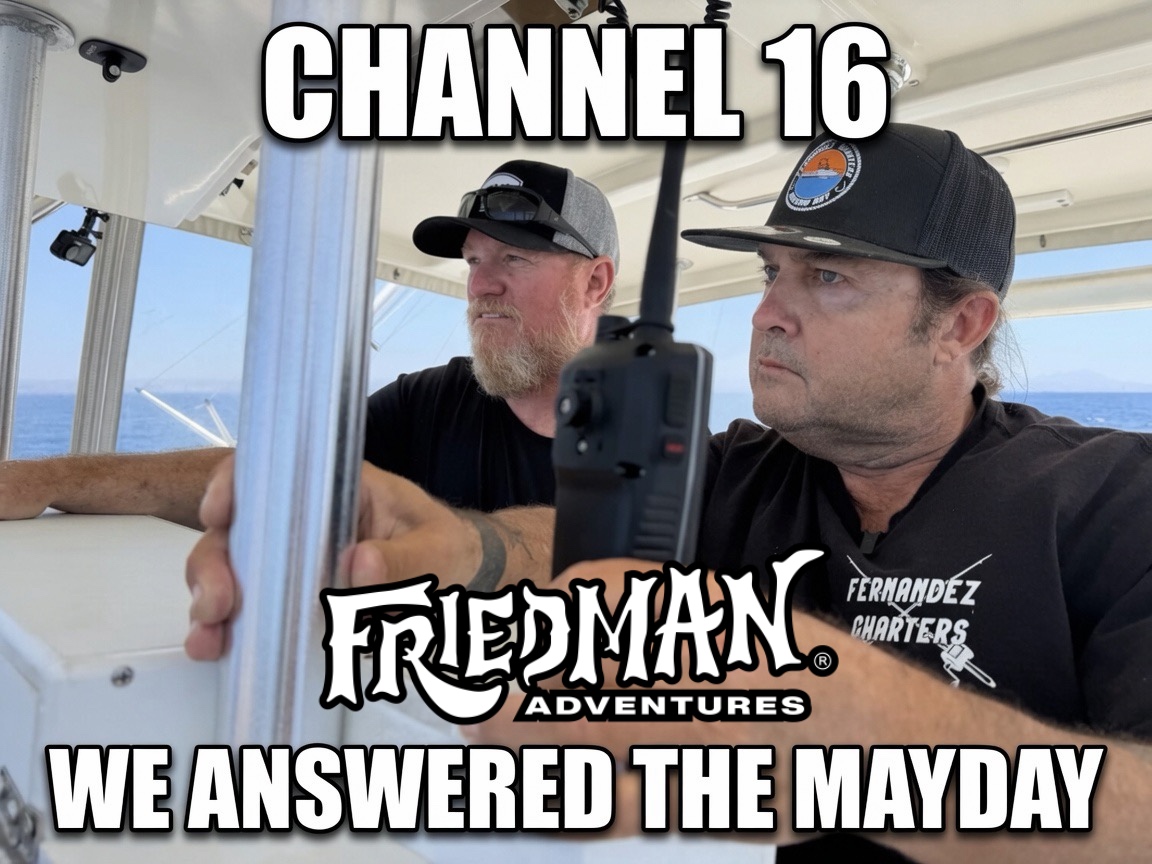
Pablo immediately went up to the helm to monitor the radios. Within moments we heard the distressed captain’s voice — there was real concern in it. He reported they were taking on water at the Rock Pile, the area just south of South Island along South Kelp Ridge. Pablo quickly asked for their position and confirmed they were in trouble.
Coast Guard Sector San Diego was already in the loop. Anthony from Mad Dog Custom Rods grabbed the binoculars and started glassing the horizon while Jeff kept the bow pointed toward the last known position. Pablo stayed on the radio, talking to both the vessel in distress and the Coast Guard, relaying information and offering assistance.
A few minutes later Anthony spotted them — a roughly 38-foot Robalo with seven people on board. One person was in the stern frantically bailing water with a small bucket. The vessel was already underway but clearly still in trouble. Pablo got on the radio and told them, “I’ve got you. I see you. We’re going to follow you and be here if you need anything.”
The captain sounded relieved — like someone had just put an angel on his wing.
Their boat was faster than ours. They were running around 35 knots while we stayed at about 16 knots, maintaining a safe following distance. Once they felt they had the water situation under enough control, they made the decision to head straight for Point Loma Sportfishing. We continued to shadow them, with Pablo giving the Coast Guard regular position updates. Anthony kept them in the binoculars the whole time. Eventually the Coast Guard made direct contact with the vessel.
We stayed with them until they were nearly back to the harbor, then did a little fishing inside and headed to the dock. Thankfully, everyone made it back safely.
The Real Story Isn’t Just What Happened — It’s What Didn’t Happen
Here’s the part that should matter to every single person who runs a boat:
There were at least eight boats fishing at South Island when that Mayday went out.
Only one vessel responded.
I’m not here to point fingers or accuse anyone. I don’t know who heard it and who didn’t. But the fact remains: when a fellow boater called for help on Channel 16, only one boat answered.
Your Moral, Ethical, and Legal Duty
Monitoring Channel 16 isn’t optional — it’s the international distress, safety, and calling channel. If you’re underway with a VHF radio on, you should be listening on 16.
More importantly, when you hear a distress call, you have an obligation to respond.
Under U.S. law (46 U.S.C. § 2304), the master of a vessel has a duty to render assistance to any person found at sea in danger of being lost, as long as it can be done without serious danger to your own vessel or crew. Internationally, the SOLAS Convention (Chapter V, Regulation 33) puts the same responsibility on every master: if you are in a position to help persons in distress at sea, you are bound to proceed to their assistance with all speed, if you can safely do so.
This isn’t just paperwork. It’s the ancient law of the sea — the recognition that out here, we are all we’ve got. When someone is taking on water, when people could end up in the ocean, when minutes matter, every capable boat becomes part of the rescue system.
Responding doesn’t always mean you have to be the one who tows them in. Sometimes it means:
• Acknowledging the call so the distressed vessel knows they’re not alone
• Relaying their position to the Coast Guard
• Standing by and providing extra eyes, extra hands, or a second radio
• Simply letting them know help is on the way
In a more serious situation — people in the water, sinking fast, medical emergency — those extra boats and extra sets of hands can make the difference between a close call and a tragedy.
The Takeaway
Channel 16 is not background noise. It is a lifeline.
When a Mayday goes out, the right response is immediate action — not silence. We were lucky yesterday. The vessel made it back under its own power with help from the Coast Guard and one responding boat. But what if the situation had been worse? What if people had been in the water? What if the only boat that responded had been too far away?
Every one of us who runs a boat carries the responsibility to answer that call.
Monitor Channel 16.
Know how to use your radio.
When you hear distress, respond.
Because one day, it might be you or someone you love who needs that voice on the other end of the radio saying, “I’ve got you. I see you. We’re on the way.”
Stay safe out there, and look out for each other.
— Phil Friedman
Friedman Adventures
#Channel16 #MaydayResponse #BoatingSafety #USCoastGuard #CoronadoIslands #SafetyAtSea #DutyToAssist #VHF #MaritimeSafety #FriedmanAdventures #FernandezCharters #JeffLaws #PabloFernandez #LookOutForEachOther #BoaterCommunity #DistressCall